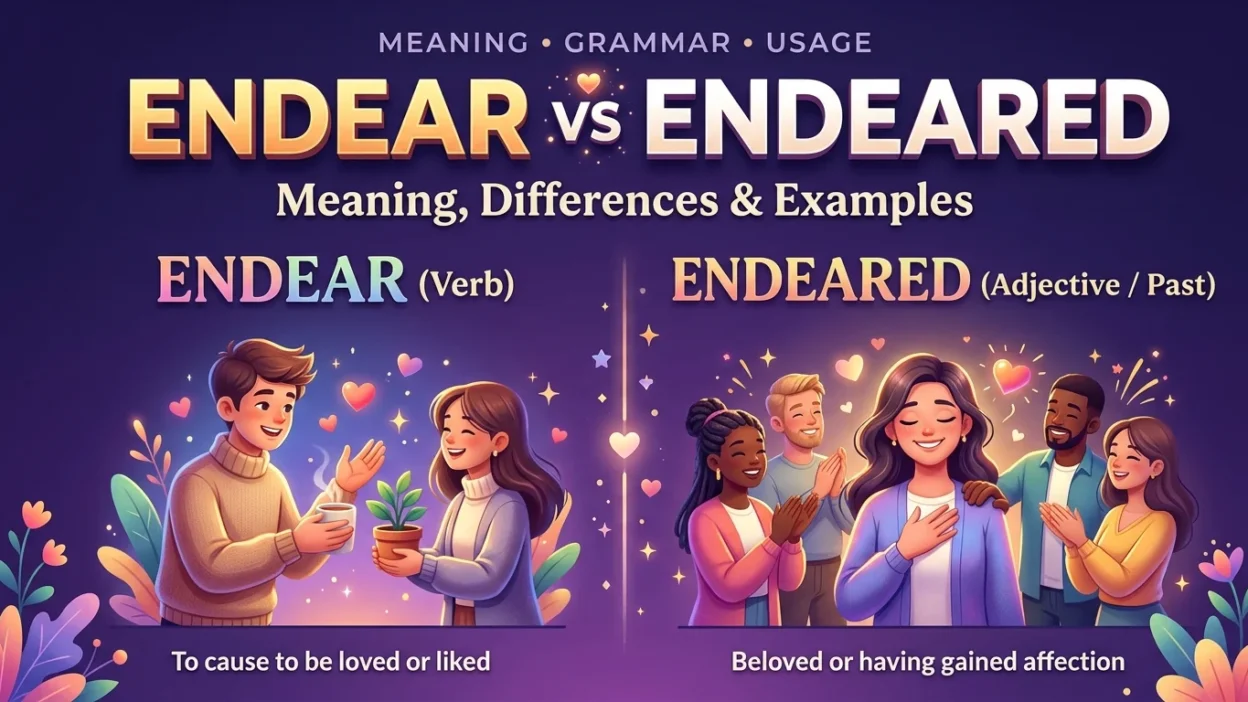
Understanding the difference between endear vs endeared can help you use both words correctly in everyday English and writing. Although they are closely related, they have different grammatical forms and uses. Endear is a verb that means to make someone liked or loved by another person, while endeared is its past-tense and past-participle form. For example, “Her kindness will endear her to everyone” describes an action, whereas “Her kindness endeared her to everyone” describes something that happened in the past.
These words often confuse English learners because they share the same root and express the idea of affection, fondness, and appreciation. However, choosing the correct form depends on the tense and sentence structure. In this guide, you will learn what endear and endeared mean, how they differ, when to use each one, and how to recognize common mistakes through simple explanations and practical examples.
Quick Answer: Endear vs Endeared
Endear is the base form of a verb meaning to make someone liked or loved by another person. Endeared is its past-tense and past-participle form. Use endear for present, future, or infinitive constructions and endeared for completed actions or perfect tenses. For example: “His honesty endeared him to us.”
Why Do People Confuse Endear and Endeared?
People often confuse these words because they have almost identical spelling and meanings. Both are connected to the idea of making someone feel affection or admiration for another person.
The main difference is grammatical rather than semantic.
Here are three reasons for the confusion:
- Similar spelling: Both words contain the same root, “endear.”
- Related meanings: Both describe the development of affection, liking, or appreciation.
- Different verb forms: One is the base form, while the other is the past-tense and past-participle form.
Understanding their grammatical roles makes choosing the correct word much easier.
1. Endear: Meaning, Definition, and Usage
Endear is a verb that means to make someone liked, loved, or appreciated by another person.
It is commonly used when someone’s behavior, personality, kindness, or actions create positive feelings in others.
Definition of Endear
- Word: Endear
- Part of speech: Verb
- Meaning: To cause someone to feel affection, liking, or admiration for another person.
- Pronunciation: /ɪnˈdɪr/
- Verb forms: Endear, endeared, endeared
A common sentence structure is:
Endear + someone + to + someone
For example:
- Her honesty endeared her to the community.
- His friendly personality endears him to everyone.
- Their kindness will endear them to their neighbors.
How to Use Endear in a Sentence
Use endear when talking about making someone liked or appreciated.
Examples:
- Her warm smile will endear her to the new students.
- His honesty helps endear him to his colleagues.
- Small acts of kindness can endear people to others.
- Her cheerful personality continues to endear her to fans.
- The teacher’s patience will endear her to the children.
Important: The expression “endear someone to someone” is the most common grammatical pattern.
2. Endeared: Meaning, Definition, and Usage
Endeared is the past-tense and past-participle form of the verb endear. It describes an action that made someone liked, loved, or appreciated.
It is often used when explaining how a person’s actions or qualities created affection in the past.
Definition of Endeared
- Word: Endeared
- Part of speech: Verb (past tense and past participle)
- Meaning: Made someone liked or loved by another person.
- Pronunciation: /ɪnˈdɪrd/
- Base form: Endear
For example:
“Her kindness endeared her to the entire neighborhood.”
This sentence means that her kindness made the people in the neighborhood like or appreciate her.
How to Use Endeared in a Sentence
Use endeared when describing a completed action or forming a perfect tense.
Examples:
- His generosity endeared him to his friends.
- Her honesty endeared her to the entire team.
- The actor’s humility endeared him to millions of fans.
- Their kindness has endeared them to the local community.
- His simple personality had endeared him to everyone.
Important: The past participle endeared can also appear with helping verbs such as has, have, and had.
Endear vs Endeared: Comparison Table
| Feature | Endear | Endeared |
|---|---|---|
| Word type | Base-form verb | Past-tense and past-participle verb |
| Meaning | To make someone liked or loved | Made someone liked or loved |
| Tense | Used in present, future, and infinitive constructions | Used in past and perfect constructions |
| Pronunciation | /ɪnˈdɪr/ | /ɪnˈdɪrd/ |
| Main purpose | Describes an action | Describes a completed action |
| Example | His kindness will endear him to us. | His kindness endeared him to us. |
| Helping verbs | Can follow will, may, can, and to | Can follow has, have, and had |
When to Use Endear vs Endeared
Choosing between these words becomes easier when you understand the time and grammatical structure of your sentence.
When to Use Endear
Use endear in these situations:
1. When describing a present or general action
- Her kindness endears her to everyone.
- His humor endears him to his classmates.
2. When talking about the future
- His actions will endear him to the audience.
- Her honesty will endear her to the new manager.
3. After modal verbs
- You can endear yourself to others through kindness.
- Small gestures may endear you to your neighbors.
4. After the word “to” in an infinitive construction
- She wants to endear herself to the team.
- He tried to endear himself to his new colleagues.
When to Use Endeared
Use endeared in these situations:
1. When describing a past action
- His kindness endeared him to his neighbors.
- Her cheerful nature endeared her to the children.
2. When using the present perfect tense
- His generosity has endeared him to many people.
- Her personality has endeared her to the audience.
3. When using the past perfect tense
- His honesty had endeared him to the entire group.
- Her dedication had endeared her to her coworkers.
12 Examples of Endear vs Endeared in Sentences
The following examples show how both words work in everyday English.
| No. | Endear Example | Endeared Example |
|---|---|---|
| 1 | Her smile will endear her to everyone. | Her smile endeared her to everyone. |
| 2 | His kindness endears him to children. | His kindness endeared him to children. |
| 3 | Honesty can endear you to others. | His honesty endeared him to others. |
| 4 | Her personality will endear her to fans. | Her personality endeared her to fans. |
| 5 | His humor helps endear him to friends. | His humor endeared him to friends. |
| 6 | Their generosity may endear them to neighbors. | Their generosity endeared them to neighbors. |
| 7 | She wants to endear herself to the team. | She endeared herself to the team. |
| 8 | His actions will endear him to the public. | His actions endeared him to the public. |
| 9 | Patience can endear a teacher to students. | Her patience endeared her to students. |
| 10 | This quality will endear him to readers. | This quality endeared him to readers. |
| 11 | His sincerity helps endear him to colleagues. | His sincerity endeared him to colleagues. |
| 12 | Her kindness continues to endear her to people. | Her kindness has endeared her to people. |
More Examples in Everyday Contexts
At work:
- His helpful attitude endears him to his coworkers.
- His willingness to help endeared him to the entire office.
In friendships:
- Her loyalty will endear her to new friends.
- Her loyalty endeared her to everyone in the group.
In family life:
- His gentle nature endears him to his grandparents.
- His thoughtful gestures endeared him to the whole family.
Common Mistakes When Using Endear and Endeared
Even advanced English learners sometimes make mistakes with these words. Here are some common errors and their corrections.
| Incorrect Sentence | Correct Sentence |
|---|---|
| His kindness will endeared him to us. | His kindness will endear him to us. |
| Her smile endear her to everyone. | Her smile endears her to everyone. |
| He has endear himself to the team. | He has endeared himself to the team. |
| She wants to endeared herself to others. | She wants to endear herself to others. |
| His honesty have endeared him to people. | His honesty has endeared him to people. |
Mistakes to Avoid
1. Using endeared after “will”
Incorrect: Her kindness will endeared her to everyone.
Correct: Her kindness will endear her to everyone.
Why? The modal verb “will” must be followed by the base form of the verb.
2. Using endear after “has”
Incorrect: His generosity has endear him to us.
Correct: His generosity has endeared him to us.
Why? The present perfect tense requires the past participle.
3. Forgetting the preposition “to”
Incorrect: His kindness endeared him everyone.
Correct: His kindness endeared him to everyone.
Why? The standard expression is “endear someone to someone.”
Memory Trick: How to Remember Endear vs Endeared
A simple memory trick can help you choose the correct word.
- Endear = Action: Think about making someone liked or loved.
- Endeared = Already happened: Think about an action completed in the past.
Remember these two examples:
- Present: His kindness will endear him to others.
- Past: His kindness endeared him to others.
You can also remember this simple grammar rule:
Will + Endear
Has/Have/Had + Endeared
This trick will help you avoid many common mistakes.
American vs British English: Is There Any Difference?
There is no meaningful difference between American and British English in the spelling, meaning, or grammatical use of endear and endeared.
Both varieties use the same forms:
| Usage | American English | British English |
|---|---|---|
| Base form | Endear | Endear |
| Past tense | Endeared | Endeared |
| Past participle | Endeared | Endeared |
| Meaning | To make someone liked or loved | To make someone liked or loved |
| Example | His kindness endeared him to us. | His kindness endeared him to us. |
The words are used in the same way in both varieties of English.
Similar Words Related to Endear and Endeared
Learning related vocabulary can help you express affection, appreciation, and positive feelings more naturally.
Here are some useful alternatives:
| Word | Meaning | Example |
|---|---|---|
| Charm | To attract or please someone | Her smile charmed everyone. |
| Attract | To draw someone’s interest | His confidence attracted attention. |
| Delight | To give someone great pleasure | Her performance delighted the audience. |
| Appeal | To be attractive or interesting | His personality appeals to many people. |
| Win over | To gain someone’s approval or affection | She quickly won over her classmates. |
| Captivate | To attract and hold someone’s attention | His speech captivated the audience. |
| Impress | To make someone admire you | Her hard work impressed the manager. |
| Endearment | A word or expression showing affection | “Sweetheart” is a common term of endearment. |
Note: These words are related in meaning, but they are not always interchangeable with endear or endeared.
Final Verdict: Endear or Endeared?
Both endear and endeared are correct English words, but they serve different grammatical purposes.
- Use endear when talking about making someone liked or appreciated, especially in present, future, and infinitive constructions.
- Use endeared when describing a completed action or forming a perfect tense.
For example:
- Correct: Her kindness will endear her to everyone.
- Correct: Her kindness endeared her to everyone.
The easiest way to choose is to check the helping verb and tense in your sentence.
Frequently Asked Questions (FAQs)
1. What is the main difference between endear and endeared?
The main difference is their grammatical form. Endear is the base form of the verb, while endeared is its past-tense and past-participle form. Both relate to making someone liked, loved, or appreciated.
2. Is endeared a correct English word?
Yes, endeared is a correct English word. It is the past-tense and past-participle form of endear. For example: “Her kindness endeared her to the community.”
3. What does endear mean in simple words?
Endear means to make someone like, love, or appreciate another person. For example: “His friendly nature endears him to everyone.”
4. Can I use endeared in the present tense?
No, endeared is not the simple present-tense form. Use endear or endears depending on the subject. For example: “His kindness endears him to others.”
However, endeared can appear in present perfect sentences, such as “He has endeared himself to everyone.”
5. What is the past tense of endear?
The past tense of endear is endeared. For example: “His generosity endeared him to his neighbors.”
6. What is the correct phrase: endear to or endeared to?
Both expressions can be correct, depending on the sentence. Use endear for the base form and endeared for the past form.
Examples:
- Her honesty will endear her to the public.
- Her honesty endeared her to the public.
7. What does “endeared himself to” mean?
“Endeared himself to” means that someone behaved in a way that made other people like, appreciate, or feel affection toward him.
For example: “He endeared himself to the team through his kindness and honesty.”
Remember This
Here is the simplest way to remember the difference:
- Endear: The base form meaning to make someone liked or loved.
- Endeared: The past-tense and past-participle form of endear.
- Endears: The simple present form used with he, she, or it.
Remember:
Endear = Making someone liked.
Endeared = Made someone liked.
Endears = Makes someone liked.
Conclusion
Understanding the difference between endear and endeared is simple once you recognize their grammatical forms. Both words describe the idea of creating affection, appreciation, or admiration, but they are used in different sentence structures. Use endear for the base form and endeared for past-tense and past-participle constructions.
if you are writing an email, having a conversation, or improving your English vocabulary, choosing the correct form makes your sentences clearer and more natural. Remember the examples and grammar rules in this guide, and you will feel more confident using both words correctly.

John Tyler is a dream researcher and content writer at SleepCout, sharing insightful articles about coded dreams, dream meanings, symbolism, sleep psychology, and practical guidance to help readers understand their dreams.